
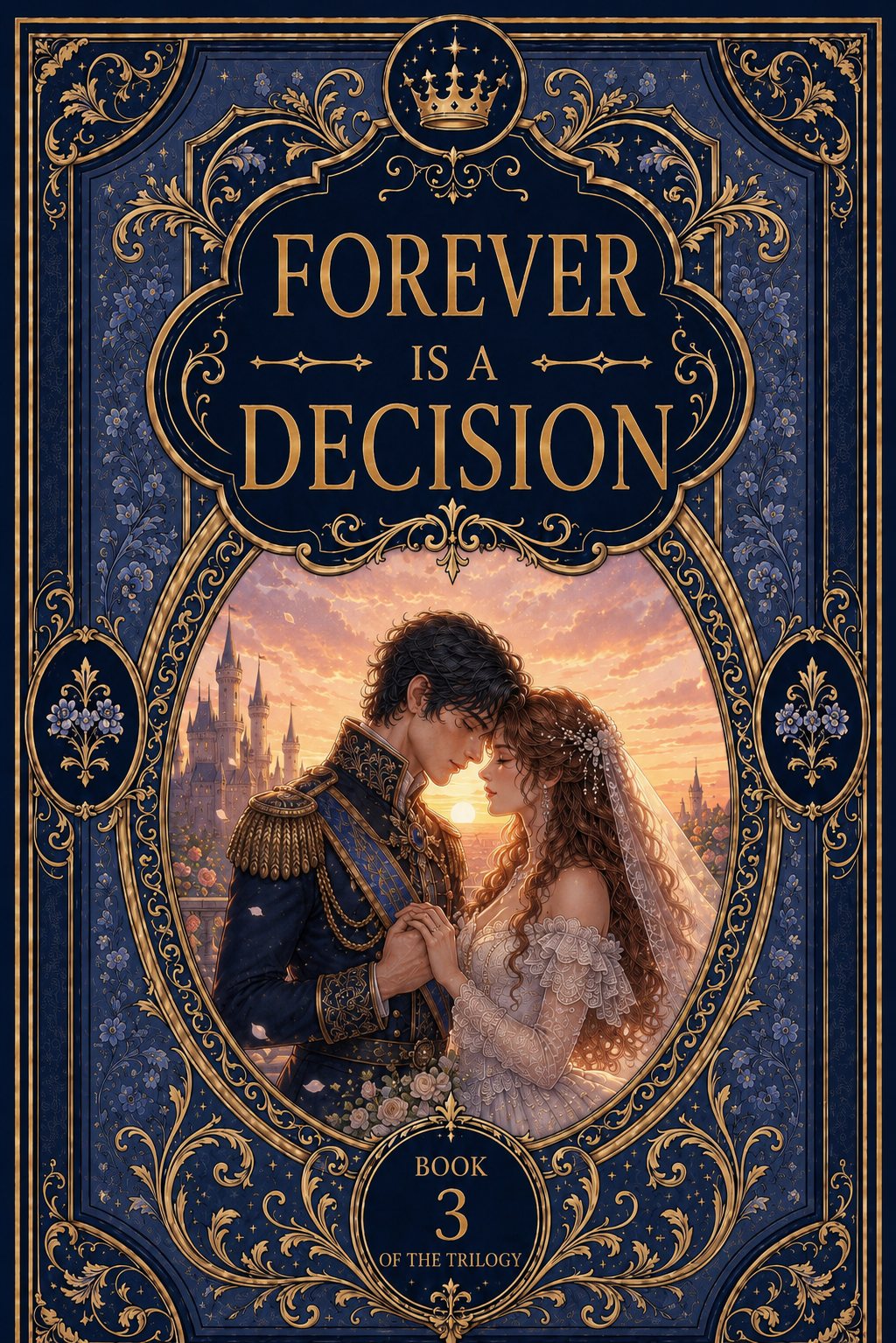
Forever Is a Decision (Book 3)
- YA
No signup, no paywall · the full story continues in the app
The story
Charlotte holds Adrian’s letter and the words chase her day and night: “If you read this, I’m already dead.” Triangular past vs. future: Adrian is Charlotte’s history and the love that shaped her; Leopold is her present and the love that grew through trust—until fear makes him pull away, shaking everything. A love story where destiny isn’t magic—it’s a daily choice, and the characters earn their “forever” through courage, sacrifice, and honesty.
Chapter 1 · The Letter That Hunts You · 9 min read
The seal of the envelope was pressed so hard into the wax that it looked bruised. Charlotte stood in the middle of her chambers in the capital, the curtains drawn tight against the late light, and turned the paper over once more as if the right angle could change the message. Her fingers smudged ink into her skin, a habit she hated because it meant she read too fast, too hungry, too afraid to miss a detail. The crest on the front was not one she recognized from court orders, only the name of her house written in Adrian’s hand—small, careful, as if he had measured each curve before he dared to send it.
Leopold had not left her alone since the messengers returned from the river road. He had insisted on staying close, on taking messages, on speaking for her when her voice failed, and she had let him because refusing him felt like refusing air. Now he stood just inside the doorway with his coat still on, his gaze fixed on her hands. He looked composed in the way a person looks composed when they are already bracing for impact. When she tore the envelope open, his shoulders shifted, like the sound of paper was a warning.
She unfolded the letter. The page was thick and faintly scented, as if it had been kept near cloth for warmth. The first line did not greet her with apology or comfort. It went straight for the wound. “If you read this, I’m already dead.” Charlotte’s breath stopped so hard it hurt.
For a moment she could only stare at the ink. The letters were steady, not the messy scratch of fear. Adrian’s handwriting always had a way of looking like control even when his words were not. This was control too, but it was control used like a blade. Leopold took one step forward, his voice low. “Charlotte—”
She held the paper up with both hands so he could not reach it first. Her throat burned. “He wrote this,” she said, and hated how it sounded like a question. She read the next line without meaning to, her eyes tracking the words like they were chasing her. “They will tell you I’m gone. Don’t let them make that the end.”
Shock came first, clean and cold. Then it broke into something worse—anger with nowhere to go. Her anger had edges, and it found Adrian’s name like a target. He had promised her a future with certainty, and now he was using the language of death as if it were a strategy. Charlotte’s fingers tightened until the paper bent, and the wax seal at the top of the page pressed into her palm.
Leopold’s hand hovered near her elbow, not touching. He knew better than to grab her. “Where did this come from?” he asked. The question was careful, but his eyes kept flicking to the letter as if it might suddenly move. He looked like a man watching a door close and still holding out hope that it would open again.
Charlotte swallowed. “It was delivered to my chambers.” Her voice came out rough, stripped by disbelief. “No one would say who had it first.”
She forced herself to read again, slower, hunting for clues the way she used to hunt for hidden meaning in Adrian’s silences. The letter was short, but every sentence was chosen. “If you read this, I’m already dead.” “I cannot stop what they will do after.” “But I can give you the next step.” And then, on the last line, a command that did not feel like goodbye: “Follow the map marked with the place. Do not wait for permission.”
Charlotte’s eyes caught on the seal symbol pressed into the wax—small, almost plain at first glance. A circle, a notch, a line that cut through it like a wound. She had seen it once before, but not in any royal registry. It sat in the back of her mind, faint, like a mark on old leather.
Leopold finally reached her, but it was too late for comfort. When his fingers touched her wrist, the contact did not calm her—it only made the grief more physical, more real. Charlotte jerked her hand away at the heat of him, the reflex of someone who had been betrayed by closeness before. Her eyes stung. “He is dead,” she said, and the words were not a fact so much as a demand the world refused to honor.
Leopold’s mouth tightened. He did not argue. He looked like he wanted to, like he had a thousand ways to explain how things could be different, but he held them all back. The restraint in him was not jealousy. It was fear, sharp and practiced, the kind that had already cost him sleep.
Charlotte lowered the letter to the table and stared at the wax again. The symbol matched a faint mark she had noticed years ago on an old family document she kept locked away in her drawer. The document had been about inheritance, about rights and signatures, about the kind of paper that decided who was allowed to exist. She had only seen the mark because she had been searching for something else—something she did not yet have words for. Now her gut insisted that the same hand, the same intention, had left that symbol in two places.
The anger shifted. Not softer—sharper. Hollow grief took its place, like a room emptied of furniture. Charlotte realized she was trembling and hated it. If Adrian had truly been taken, then someone had used his death as a message. If he had not—then the lie was worse than the death.
She looked at Leopold. “You’ve known something,” she said, because the way he braced had not begun with the messenger. It had lived in him from the start. His eyes flicked down, then back up. “I know what I’m allowed to know,” he replied. It was the closest he came to honesty, and it still felt like a wall.
Charlotte pushed the letter forward so he could read the seal again, as if sharing the view would force him to share the truth. “Why would he write this if he was already gone?” Her voice broke on gone, and she corrected herself with a sharper edge. “Why would he write as if he expects me to move?”
Leopold’s gaze stayed on her face, not the paper. “Because he is Adrian,” he said, and the words were almost tender. Then the tenderness failed, replaced by something tighter. “Because he always planned for what came after.”
Charlotte’s anger rose again, but now it had a direction. Mission-driven grief. She refused to accept dead as an end point. If Adrian had left her a next step, then the story was not finished. She stood straight, the letter in her hand like a weapon she had not known she could carry. “Show me the map,” she said.
Leopold’s eyes widened for a heartbeat. He reached into the inside pocket of his coat and drew out a folded sheet wrapped in oilcloth. The motion was slow, deliberate, like he was lifting something that could burn. “It was kept with the documents you requested,” he said. “It came from the same chain as this letter.”
Charlotte’s breath caught at the confirmation of what she feared. The letter and the map were tied together, and someone had decided she would receive both. She set her palm on the oilcloth but did not unfold it yet. “If Adrian is presumed dead,” she said, tasting each word, “then why does this feel like a schedule?”
Leopold’s jaw worked. “Because the people who benefit from the lie are already moving,” he said. He looked at the wax seal again, then away. “And because the date matters.”
Charlotte hated how calm that sounded. Her grief wanted chaos, wanted screaming, wanted to break something. Instead, it turned into focus. She unfolded the oilcloth just enough to see a portion of parchment. A small illustration of roads and water lines lay over a blank stretch, and one marked place was circled with a dark ink that had soaked deep into the fibers.
She blinked, and her eyes adjusted to the corner. There, pressed into the parchment like a cut that had been made with a careful tool, was a date. She leaned closer, her heart thudding as if it could bruise the truth out of the paper.
The date did not match the timing of the messenger’s report. It did not match what she had been told about Adrian’s death. It was too early, carved as if the letter had been prepared before the world officially closed around him.
Leopold watched her read it, his face pale under the lamp light. “This is why I didn’t want you to see it alone,” he said quietly. His voice carried no anger at her, only exhaustion. “Because once you know, you will move.”
Charlotte looked at him, and the hollow grief inside her shifted again—into something that could become fury or purpose, she wasn’t sure which yet. She held the map steady with both hands. “Adrian wrote as if he was already dead,” she said. “This date says he had time.”