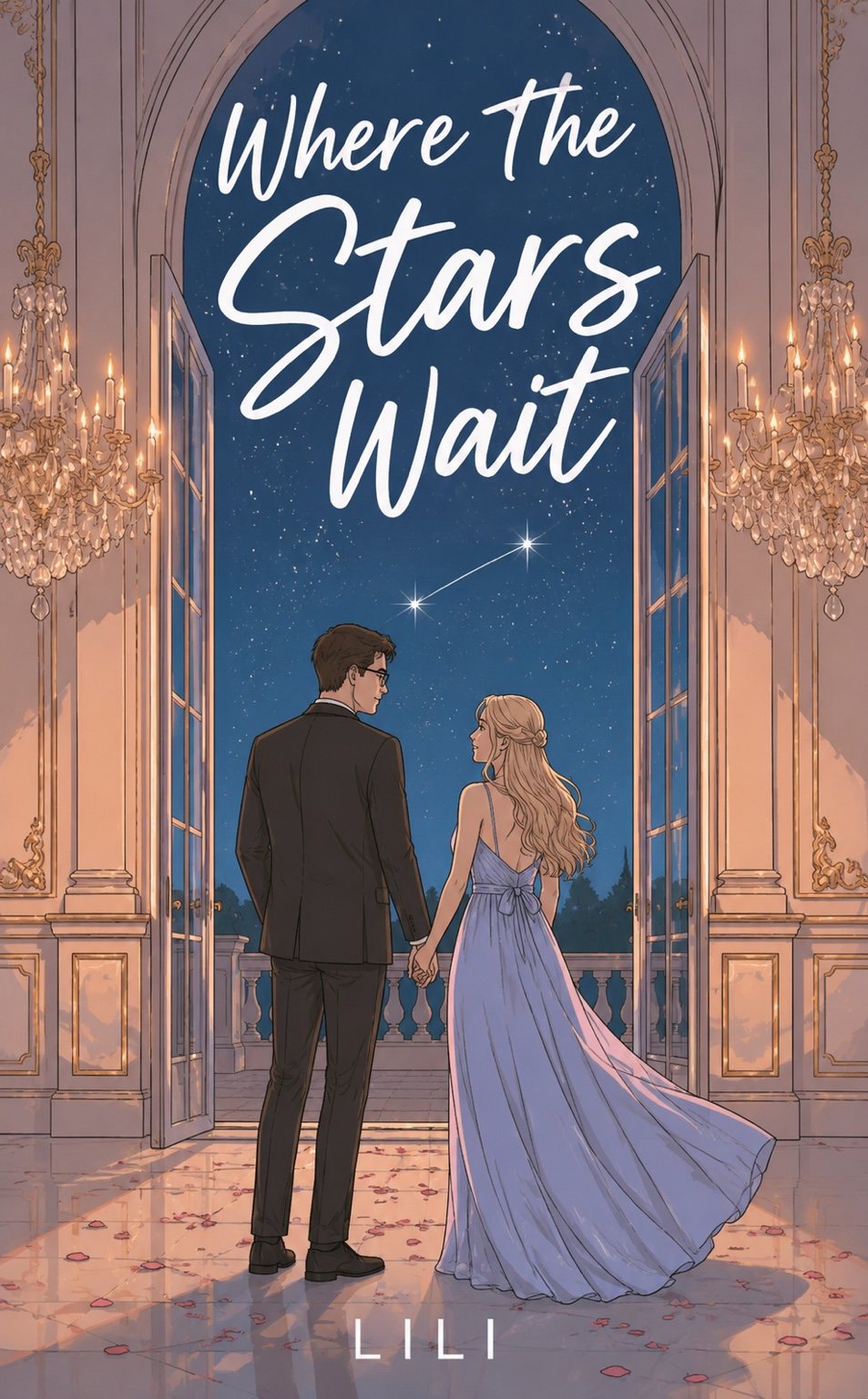
Where the Stars Wait
No signup, no paywall · the full story continues in the app
The story
A world-famous orchestra starts the very piece that has haunted a woman since childhood—only to realize the man conducting it is the one person she’s been searching for across lifetimes. Two souls who find each other instantly through instinct and small, intimate rituals—one charts the night sky, the other listens until a melody becomes a promise. Quiet, chosen love that survives illness, war, fire, shipwreck, and time—answered by the sky itself.
Chapter 1 · The Melody That Won’t Finish · 11 min read
The backstage corridor outside the concert hall smelled like dust warmed by stage lights. My sheet music sat open on the edge of a prop table, corners weighted with rosin tins, and the pencil marks in my own handwriting looked too sharp for how tired my hands felt. I had been running the same page in my head for hours—counting bars, fixing breaths, smoothing the parts that always snagged on the last phrase—yet my eyes kept drifting to the thin blank space where the melody refused to finish.
I’d carried that unfinished line since childhood. Not the whole thing, not the comfort of a complete score, just the missing note like a tooth you can’t stop touching with your tongue. Adults had called it imagination. Teachers had called it a habit. I’d called it nothing, because calling it anything made it louder in my chest.
Now, with the hall’s doors shut and the crowd still trapped behind velvet curtains, the building should have stayed silent. Instead, a faint melody leaked through the walls—so soft it could have been someone tuning a piano behind a closed door. Three notes rose, then paused, then the next line tried to form, as if the air itself remembered how to play but didn’t know the ending.
My fingers went numb around the edge of my score. Confusion came first, neat and sensible, like a voice in my head trying to label the sound as coincidence. Then panic snapped in, sharp and personal, because my body reacted the way it always did when certain notes touched the right pitch. My throat tightened. My heart sped up like it had been given an order.
The melody wasn’t part of the rehearsal schedule. I knew the schedule the way I knew my own scales: by muscle, by breath, by the small pain in my joints after too many practice hours. This tune moved wrong. It didn’t match any warm-up I’d ever done, and it didn’t match any program piece I’d prepared for tonight.
I stopped moving completely. One second I was a soloist with a debut to protect; the next second I was a child standing in a hallway that no longer existed, listening as if someone called my name from behind a wall. My lungs forgot how to work. The corridor’s light seemed to flicker, not from the bulbs, but from inside my eyes.
I forced my gaze down to my bracelet, like looking at something solid could undo what I’d heard. A small silver star clasp fastened it at my wrist, and I hadn’t worn it today for any practical reason. It sat there anyway, warm as if recently touched. Heat shouldn’t have come from metal in an unheated corridor.
My breath came in thin pieces. I tried again to find the source of the sound, to map it like music theory. The notes were faint but repeatable, and every time the melody turned toward the missing note, my body flinched the same way. Not fear of the sound—recognition of it.
I lifted my sheet music with both hands, careful, as if the paper might break under my grip. The blank space near the end of the line glared at me. I could almost see the missing note written there in my mind, black ink on white, but when I reached for it, my thoughts slid away like water over stone.
Footsteps approached from the far end of the corridor—measured, not hurried. A quiet man appeared in the strip of light between doorways, pausing as if he’d almost walked past me and then changed his mind. He wore a simple jacket and carried nothing flashy, but his hands caught the glow: ink-stained, careful, with a faint callus along one finger like he spent hours mapping lines no one else could see.
I should have asked who he was. I should have checked my memory for his face from rehearsal, from the orchestra’s hallways, from interviews and rehearsals. Instead, my mind offered a wrong kind of certainty, the kind you feel in dreams right before you wake up.
He looked at my score first, then at my bracelet, then back to my face. His gaze didn’t linger like a stare; it landed like a question he refused to ask loudly. The melody in the walls shifted, just a fraction, as if it had noticed him too.
I swallowed. My voice came out smaller than I wanted. “Do you hear it?”
The man’s mouth parted, then closed again. He glanced toward the concert hall doors, as if listening through them. “I thought I was imagining it,” he said, soft and precise. “It’s… familiar.”
Familiar. That word hit me like a hand on my ribs. I had spent years telling myself familiarity didn’t mean anything. It was a trick of the brain, a pattern-seeking habit. Yet my skin still remembered the notes, still treated them like a key turning in a lock.
He stepped closer. The corridor seemed to narrow around us. My sheet music trembled in my grip, and for a second I thought I would drop it. The silver star clasp on my bracelet turned hotter, and the warmth spread up my wrist as if it were answering him.
When he looked at me again, the feeling of coming home struck so hard I nearly lost my balance. It wasn’t gentle. It was a wave with a name I couldn’t say. I had never felt it with anyone in my life, and yet my body reacted like it had been trained for this exact moment.
His eyes flicked to my hands. “You’re holding it like it hurts,” he murmured.
I tried to laugh, but the sound came out thin. “It does.” I forced myself to steady my fingers on the paper. “This melody is—” I stopped. Saying the word unfinished felt like inviting the wrong memory to become real.
The man’s posture changed slightly, as if he’d heard an instrument tuning to the wrong note and felt the need to correct it. He reached into his jacket and pulled out a folded sheet. Not music, not a program—just paper with lines and symbols, drawn in ink that looked too dark to be accidental.
He didn’t hand it to me. He held it at his side like he was afraid of what it might do if he moved too fast. “I map things,” he said. “Stars, mostly. Patterns.”
The melody through the walls tightened into a clearer shape. The notes rose like steps toward a door that had been closed for years. I felt my panic climb higher, not because the man was threatening, but because he was standing too close to the place in my mind where the missing note lived.
I looked at his hands again. The ink stains weren’t neat. They were the kind you get when you press too hard, when you redraw the same line until it finally behaves. It felt like watching someone trace an invisible map over and over, hoping it would become visible.
“Who are you?” I asked, and my own question sounded like a plea to the air.
He hesitated, then shifted his gaze to my score. “I’m supposed to be here,” he said. “For tonight.”
Supposed to be here. My chest tightened again. Tonight was already full of rehearsals and schedules and practiced smiles. A stranger could be arranged into any plan. But the melody didn’t feel arranged. It felt older than the building, older than this city, like it had been waiting under the stone for someone to listen at the right angle.
My fingers slid on the edge of the page. The blank space near the end seemed to breathe, as if it were alive and leaning toward the sound. The silver star clasp on my bracelet pulsed with warmth once, then steadied.
The man took one more step. “Don’t stop playing it,” he said, and his voice broke on the last word like he’d meant it more than once before. “Even when it doesn’t finish.”
I stared at him. He had no reason to know how I felt about the missing note. He hadn’t seen my childhood sketches. He hadn’t watched me practice alone at night with the lights low, trying to coax that last note out of silence.
My breath came fast. “I didn’t tell you that,” I said.
His eyes softened, and for an instant the corridor blurred. Not from tears—my eyes stayed dry—but from the force of recognition that had nothing to do with manners and everything to do with memory my mind refused to own.
The melody through the walls swelled, faint but insistent, and it matched the exact direction my unfinished line always wanted to go. The next note hovered in the air like a breath held too long. My body leaned toward it, helpless and hungry.
The man finally glanced down at my score, close enough that I could see the fine tremor in his fingers when he traced the page without touching it. “I know this,” he said. “I know the note you never wrote.”
I felt my panic turn into something sharper—fear that if he spoke the wrong thing, the world would take it away again. “Then tell me,” I whispered, because the melody demanded an answer.
He looked at me as if he was choosing honesty over safety. Then, very gently, he added a sentence that sounded like a memory he shouldn’t have. “You left it for me the night the hall vanished.”