
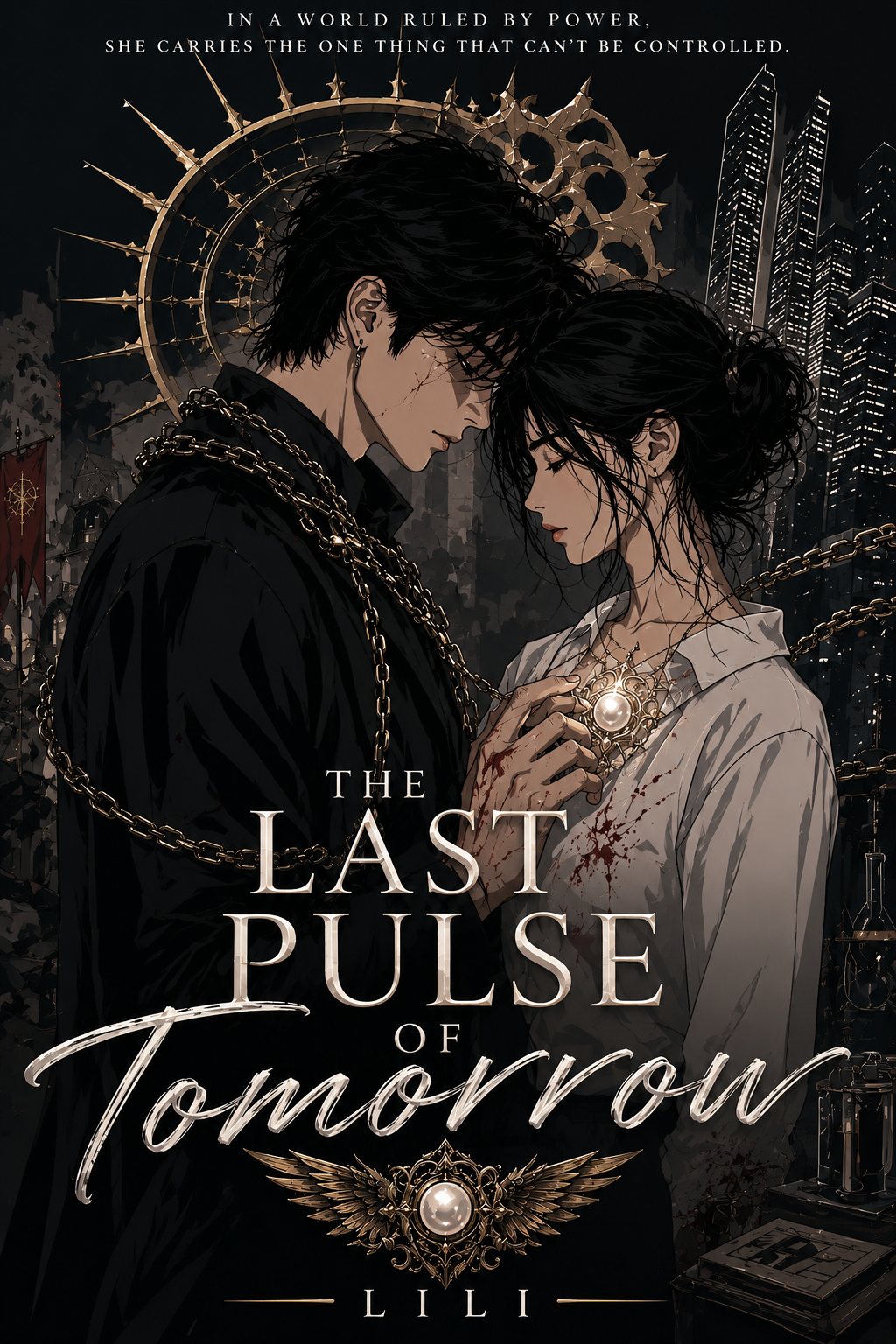
The Last Pulse of Tomorrow
- Sci
No signup, no paywall · the full story continues in the app
The story
In the lab, Dr. Elian Voss watches a researcher drop dead mid-sentence—then realizes it wasn’t a random accident: someone is trying to reach the heartbeat inside her chest. Forbidden protector + reluctant pursuer: Kael hunts Elian like a weapon, but his power fails, forcing him to watch, question, and choose her over his clan—until their bond becomes mutual courage. To feel safe enough to fall in love while the world tries to control your body—and to believe love can undo even the most terrifying power.
Chapter 1 · The Lab Accident That Wasn’t · 9 min read
The research wing was quiet in the way hospitals tried to be quiet. Soft lights. Smooth floors. The hum of machines that never slept. I stood by the vascular scanner, sleeves rolled to my elbows, and watched Dr. Marek Lenn’s hands hover over the next run like he could smooth out the day by being careful enough.
Marek smiled at me without showing his tired eyes. “It’s a routine scan,” he said. “No new variables. No rush.” He tapped the consent panel with his pen, then leaned closer to the screen. “Elian, your last results were clean.”
My throat tightened at the word clean. Clean was what people called results when they wanted the story to end. I had been watching numbers all week that didn’t fit the usual patterns. Not wrong enough for a complaint. Not strange enough for anyone to listen.
Marek cleared his throat. “We run the protocol again. We confirm immunity response curves. Then we submit for review.” His voice sped up at the end, like he was already trying to outrun politics.
The patient was not in the chair. This was our internal test. A mannequin with a blood-flow simulator. Marek’s reason was simple: if the equipment read stable, then the anomaly had to be in the sample. His reason was always simple when his fear needed a shape.
I adjusted the scanner settings and brought up Marek’s latest dataset. The interface painted a thin path of light across the model’s vessels. The numbers moved like they always did. Then, for a blink, there was a ‘light edge’ at the border of the readout.
I leaned in, then straightened, telling myself it was a calibration artifact. If I made it real in my head, I would have to explain it to Marek. And I knew how that would go. He would laugh at my fear and call it lab stress.
“Start,” Marek said.
The simulator’s pulse graph began to climb, smooth and predictable. I watched the waveform and the micro-vascular stability markers. My own body felt normal, warm but steady. I had learned to ignore the small oddities in me. If I did not, I would spend my whole life measuring my own heartbeat like it was a suspect.
Marek’s face changed first. His pen stopped moving. His smile fell off his mouth like it had been cut. He stared at the screen as if the light had suddenly become language.
“That shouldn’t—” He swallowed. The next word got stuck. His hand went to his throat, fingers pressing too hard, like he could hold his blood in place by force.
I stepped forward. “Marek. Talk to me.”
He tried to speak again. His eyes flicked to mine, wide and wrong, and then he collapsed beside the scanner chair. The body hit the floor with a dull sound, not dramatic, just final.
For a second I thought, *accident*. A stroke. A clot. A heart event we missed. My hands moved before my mind finished searching. I checked his pulse on instinct, then his skin temperature, then his airway. Cold sweat broke across my palms.
The monitor flatlined. Marek’s eyes stayed open. There was no breath, no rise and fall, just the blank stare of a man who had been mid-sentence a moment ago.
I leaned over him, then forced myself back to the scanner readout. If this was random, the machine would show noise. If it was a target, the pattern would repeat.
The vascular scan had logged a cascade that looked almost too clean. The simulator model had spiked, then snapped into a stable curve that did not match the protocol. The ‘light edge’ flashed again on the edge of the display, like a glitch trying to be seen.
I pulled up the last screen Marek had been viewing. There were code fragments in the corner, half-hidden behind the lab interface. Marek had never been a programmer. He was a scientist who trusted systems to behave.
The fragment looked like a partial sequence, bracketed and cut short, as if someone had started to write and then changed their mind. My eyes caught on a symbol that made my stomach twist. I had seen it once before in a training module, years ago, when I was still allowed to be a student and not a target.
My fear tightened into a cold ring. Someone had used the scanner to reach Marek. Not by accident. By timing. By choice.
I grabbed Marek’s wrist for a second more, checking as if I could bargain with biology. Nothing. No pulse. No warmth returning. The lab smelled suddenly like antiseptic and metal.
A sound came from the corridor beyond the lab door. Footsteps. Not staff. Too controlled. I stood too fast and my vision swam. I forced my breathing steady, then moved to the glass panel set into the door, using it like a mirror.
In the reflection, a person stood at the end of the hallway. Dark coat. Still posture. The lights made their face unreadable, but their head was angled as if they were watching the scanner screen through the glass.
My heart should have spiked from adrenaline. It didn’t. My pulse kept its rhythm like it was protected from the room’s panic. I felt it in the back of my throat, steady and sure, even as my hands shook.
I turned toward the door handle, but the corridor was empty when I looked straight. No footsteps. No coat. Only the hum of lights and the faint echo of my own breathing.
I checked the scanner logs again, slower this time. The death event had been written into the machine’s readout with a precision that felt like handwriting. Astrek-style blood manipulation could be camouflaged as lab accidents. I had only ever learned that in theory and rumor, the kind of knowledge you kept behind locked doors.
Now it stood in front of me, using Marek’s body as proof.
I moved Marek’s body onto a clean sheet and called the emergency line. My voice came out calm, too calm. “We have a lab incident. Please send medical and security to wing four. Doctor Marek Lenn.”
As I spoke, I kept watching the monitor. The simulator’s waveform stayed stable. My body stayed stable. It was like the attack had been pointed at him and then… refused to finish the job.
But my pulse did not spike. It stayed steady, as if my bloodstream had been given a script that said *not today*.
The nurse who arrived first looked at Marek and then at me with that careful hospital face. “Dr. Voss, are you okay?”
I swallowed. “I’m fine.” I was not. My fear was too tight. But I wasn’t going to give anyone the satisfaction of seeing me crack. “Can you secure the lab? No one touches the scanner logs.”
She nodded too fast. “Yes, of course.” Her eyes slid once to the corner of the screen where the code fragment sat. She did not understand what she was seeing, but she knew it looked wrong.
Later, when security finally arrived, I sat in the small waiting room outside my wing with Marek’s last dataset open on my tablet. The staff moved around me, slow and official, as if the right paperwork could undo death.
I replayed the moment again and again. Marek’s collapse had not looked like a heart attack. It had looked like something had pulled on the blood system like a string, then released it when it was done.
On my screen, the code fragment remained stubborn. I tried simple decodes, then more advanced ones, using the training patterns I had kept locked away. Nothing fit. It was missing a piece, like a message cut in half.
My hands hovered above the keyboard. If I wrote to someone, I risked sending the clue to the wrong person. If I stayed silent, I risked dying with Marek.
I stood and returned to the lab door. The glass panel still held the corridor reflection. I stared until my eyes hurt. No one stood there this time.
That night, after the hospital lights dimmed and staff moved like shadows, I locked my office and checked my pulse again, just to be sure. Steady. Calm. Protected.
I had never asked my body to be a shield. I had only asked it to survive my work. Now survival felt like a message.
At 23:17, there was a knock at the outer door. No voice. Just a single knock like a signal. The security guard on duty didn’t step inside. He only pointed at a sealed envelope resting on the floor by the handle.
The seal was clean. No sender stamp. No hospital mark. My name was written in neat ink that looked too confident to be random.
I picked it up with two fingers. The paper was warm, like it had been held close to skin. My pulse stayed steady as I broke the seal.