
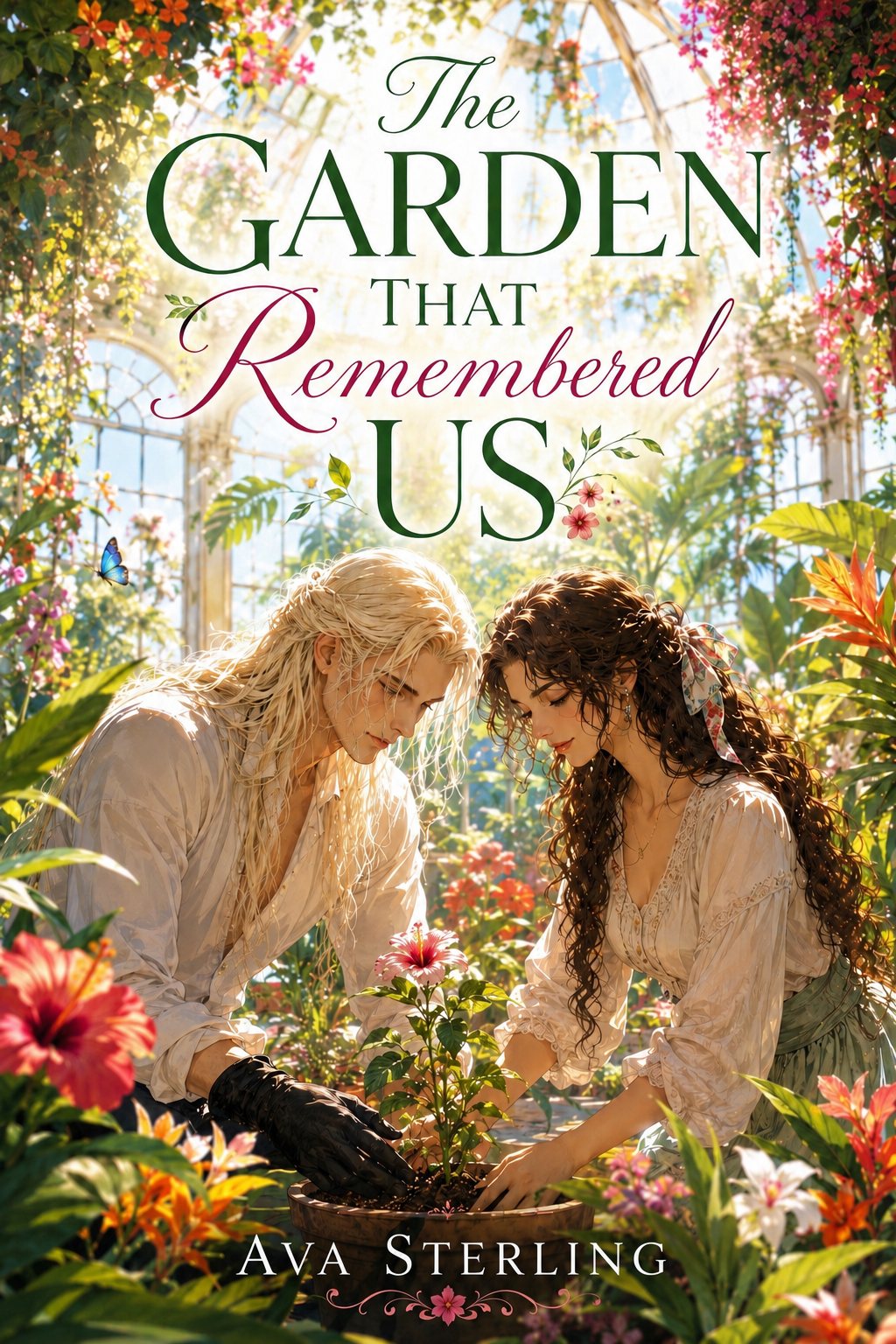
Cover of The Garden That Remembered Us

by Ava Sterling

The Garden That Remembered Us

  • Royal Romance
Read full first chapter

No signup, no paywall · the full story continues in the app

40Public chapters
10 minFirst chapter
EnglishLanguage
Jun 26, 2026Last updated

The story

On a misty autumn morning, Evelyn finds a rare plant blooming over a spot where Caelan’s gloved hand hovered—yet every rumor says his touch kills anything alive. Two guarded people: Evelyn hides in routines and devotion to plants; Caelan hides behind silence, gloves, and self-sacrifice—until their shared work forces honest closeness. Trust heals—love can be gentle, stubborn, and powerful enough to rewrite the story of a wound and a curse.

Chapter 1 · The Glass That Holds Its Breath · 10 min read

Mist pressed against the glass ceiling of the Forgotten Royal Conservatory like a slow breath held too long. Evelyn Marrowe moved along the central aisle with her sleeves rolled to the elbow, hands already stained with soil and soot from the last failed patch of compost. The greenhouse had been neglected until it began to fail in small, stubborn ways: leaves yellowed early, the heat vents rattled like loose bones, and the air grew too still, as if the plants were waiting for someone to remember them.

She knelt beside a row of dying beds where the richest orchids should have been blooming. Their stems were thin, their petals curled inward, and their scent had gone flat—no sweetness, only a faint damp bitterness. Evelyn checked the moisture with two careful fingers, then pressed her palm to the pot rim to feel the temperature. The greenhouse responded with small honesty: warm where it still had life to spend, cool where it had given up.

A kettle hissed somewhere behind her, but the sound felt wrong in the glass hush. Evelyn dipped a ladle into the watering basin and poured in a thin ribbon, watching the soil darken and loosen. She had learned to listen for what the greenhouse gave back. When she fed it gently, the plants held themselves straighter; when she forced a solution, they sulked for days.

The first bed was already turning, just slightly, its newest leaf unfurling from a tight fist of green. Evelyn let out a breath she had not realized she was holding. Routine kept her safe. Routine kept her from thinking about the way her family had been ruined by nobles who valued power more than kindness, and the way she had sworn, afterward, that she would never put her devotion into human hands again.

The click came again, barely audible under the mist and the distant drip of water pipes. Evelyn froze with the ladle half-raised. The conservatory should have been empty at this hour. The side doors were sealed from the outside. The central lock was still latched where she had checked it last night.

She set the ladle down and stood slowly, knees stiff from kneeling too long. Her eyes swept the greenhouse interior: tiers of benches, hanging baskets, the cracked ceramic pots lined like pale teeth. At the far end, near the neglected wall vents, a narrow side door sat half-hidden behind a curtain of climbing vines. The curtain stirred as if something had passed.

Caelan appeared from that hidden side door as if the conservatory had decided to exhale him. He wore a long coat with a high collar, pale hair falling in controlled strands. His gloves were black—thick, fitted, and unmarred, except for faint runic seams that seemed to drink the light. He stepped into the misty aisle with careful weight, then stopped, keeping his hands close to his body.

Evelyn’s throat tightened. She had heard the stories in the city markets and in the servants’ kitchens: that Caelan Veylorn’s touch killed anything alive, that he had brought death into rooms simply by reaching. The rumor always described him as untouchable, as if his skin itself was a weapon. Yet he moved like someone afraid to startle a sleeping animal.

He did not look at her at first. His gaze went to the beds, to the curled petals, to the pot rims she had just warmed. His attention settled on the dying orchids with a kind of quiet precision, like he could measure their suffering by sight alone.

Her voice surprised her with how steady it was. It came out soft, careful, as if she were speaking to the plants to keep them from panicking. Caelan’s head turned toward her at last. His eyes were pale, almost silver under the greenhouse light, and they held hers without meeting too deeply, like he was counting the distance between them.

The word sat between them too cleanly. Evelyn had watched men lie with their mouths and then reveal truth by their hands. Caelan’s hands were gloved—always gloved—and he kept them still, as if movement might cost him something.

Evelyn stepped closer to the nearest bed, putting herself between him and the orchids as if her body could form a barrier against a rumor. “Helping,” she repeated, and she made the word sound like a test. “Then tell me why the soil near this bed is still warm.”

Caelan’s gaze dropped, not to her face, but to the patch of ground at the edge of the ceramic pot. His mouth tightened. The greenhouse clicked again, faint and expectant, like a latch waiting for the next decision.

He shifted his weight and lifted one gloved hand, hovering above the soil without touching. The air between his glove and the earth felt warmer than the rest of the bed, a small heat pocket that did not match the greenhouse’s failing vents. Evelyn felt her fear argue with her curiosity. If his touch truly killed, why did the soil respond like it was being fed?

A bud sat half-buried in the potting mix, no larger than a fingernail. It had been tight and lifeless yesterday, its edges darkening toward wilt. Now, at the center of the bud, a green seam opened as if it had been waiting for warmth to decide it was allowed to live.

Evelyn swallowed. The rumor had teeth. It said his touch ended life. Her hands had ended life too, once, by accident and neglect, when she was younger and angry at the world. She could not afford to believe in miracles just because they looked like relief.

Caelan avoided eye contact when she said it. His gaze flicked to the cracked ceramic pot rim instead, where the faintest mark sat like an old scar: a scrap of old glove-ward rune, chipped and dry, half-hidden in the glaze break. Evelyn had noticed it before, only once, and had told herself it was coincidence—an artifact left by the greenhouse’s original caretakers.

Now she could not ignore the match between that rune and the seam pattern on his glove. The greenhouse clicked once, sharper this time, as if it was recognizing a language.

His voice stayed low, measured. He sounded like someone stating a fact he had learned the hard way. Evelyn studied his gloves instead of his face. The black leather looked too intact, too cared for, as if it had been repaired often. The runic seams did not glow, but they seemed to drink light and hold it.

Evelyn’s fear shifted shape. It became not only dread, but suspicion. “If you’re only helping,” she said, “then why do you hover and never touch?”

Caelan drew his hovering hand back a fraction. The warmed patch of soil cooled by a breath’s worth of time. The bud did not collapse. It stayed tight, as if it was deciding whether to trust the world again.

Caelan stepped closer to the bed, but he kept the distance that made Evelyn feel in charge. He did not ask her permission to move the watering channel, only lifted it with careful fingers and set it where the runoff would reach the roots without flooding the crown. The motion was precise, gentle, almost reverent. Evelyn watched his hands like they were dangerous animals, because the rumor had taught her that gentleness could still be deadly.

Then he stopped. His gloved knuckles hovered near the rim of the pot, and his shoulders tightened as if he had hit a boundary only he could feel. He looked at the soil as though it might answer him. The greenhouse clicked again—an agreement sound, small and bright.

Evelyn reached for the bud with her bare fingers, intending to check whether it was truly alive or only pretending to be. The moment her skin neared the pot rim, Caelan’s attention snapped to her hand. His body moved before his voice could stop it. He grabbed her wrist—firm, but not hurting—his glove pressed against her skin just enough to make her gasp.

For a heartbeat, Evelyn thought he had finally decided to prove the worst story. But Caelan did not squeeze. He held her wrist steady and then stilled, as if something inside the glove had warned him. His breathing slowed, and his eyes flicked to the seam on his glove like it had spoken.

His grip tightened once, then eased. Caelan released her with a careful gentleness that did not match the violence her fear expected. Evelyn rubbed her wrist where his glove had touched, feeling heat bloom under the skin, not harm. The bud in the pot tightened further, as if pleased by restraint.

Evelyn stared at his glove, then at the pot rim with the old rune scrap. Her mind tried to arrange the facts into a safe pattern: neglected greenhouse that still responded to care; her belief that flowers were safer than people; Caelan rumored to kill with touch. Something did not fit.

Caelan leaned closer to the bed, but he angled his glove away from her again, keeping the warmed soil between them like a boundary neither of them could cross. He finally met her eyes. “Don’t,” he said, and the word carried more fear than command.

Evelyn’s heart beat too hard in her chest. She wanted to pull her hand back, but the bud’s life felt like a promise. She wanted to grab the truth by the root, even if it bruised her. When she lowered her fingers again toward the warmed patch, Caelan’s glove shifted as if to catch her wrist a second time—then stopped.

It’s just getting good.

Don’t stop on a cliffhanger.

The rest of The Garden That Remembered Us is waiting in the app. A free chapter unlocks every few hours, or you can keep reading right away.

Download on the App Store