
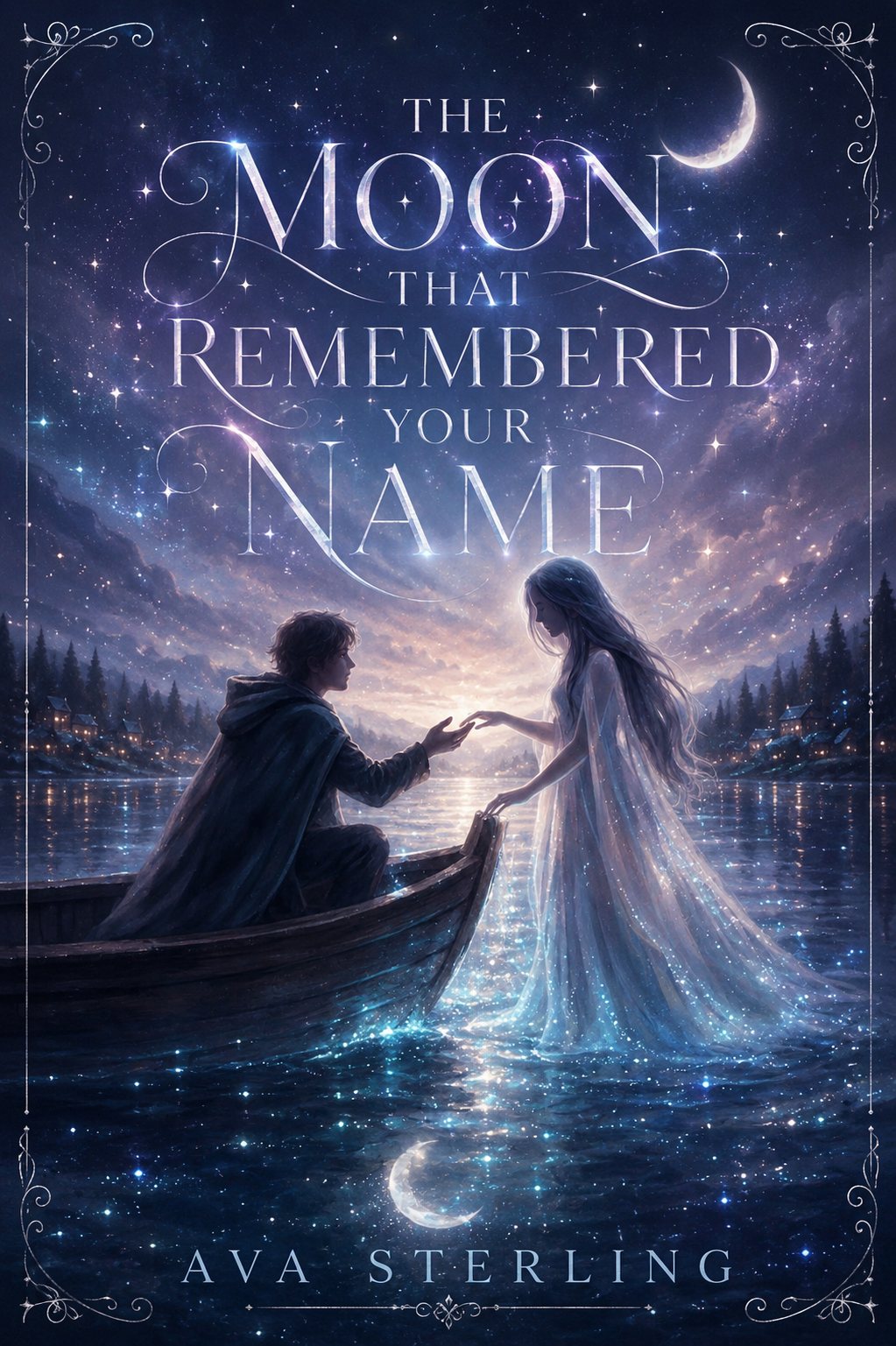
Cover of The Moon That Remembered Your Name

by Ava Sterling

The Moon That Remembered Your Name

  • Fae & Court Fantasy
Read full first chapter

No signup, no paywall · the full story continues in the app

40Public chapters
9 minFirst chapter
EnglishLanguage
Jun 26, 2026Last updated

The story

On the first full moon Elias Rowan sees a woman walking over water like it is solid ground—right toward him—while the village warns that touching her means vanishing forever at sunrise. Mortal skeptic + ancient moon-guardian: Elias brings logic, maps, and stubborn hope; Selene brings lyrical stories, quiet power, and a protective guilt that she tries to hide. Tender love under a terrifying curse: intimacy that hurts, romance that feels like fate, and the hope of a “second first love” where choice survives memory loss.

Chapter 1 · Moon Over Water · 9 min read

The full moon hung over Lake Noctis like a coin pressed into dark water. Elias Rowan tightened the strap on his leather satchel and checked the compass chain at his throat, as if the metal could keep the night honest. He stood on the muddy shore with his survey pole planted in the earth and his notebook open, waiting for the lake to show him what it always refused to show in daylight.

Behind him, the village sounded too quiet. No laughter. No distant hammering. Even the wind seemed to hold its breath, sliding through reed tops without making a real sound. Elias told himself it was just superstition, just people making patterns out of fear. He had heard their warnings since he was old enough to hold a pencil, and he had still come here because no legend could measure itself.

He made a small mark in his notebook and stared at the water. Under moonlight, the lake looked normal at first—black glass, ripples like thin handwriting. Then the surface shifted, and the reflected moon-silver broke into something sharper, like a blade pretending to be a circle. Elias leaned closer, breath fogging his lips in the cold, and his cartographer’s brain caught on one detail: a faint reflection of a moon-sickle in the water.

The reflection vanished when he blinked. Not gradually—gone like a page turned too fast. Elias swallowed and drew in a careful line, the kind he used to steady himself. He had planned to take three observations tonight. He had planned to leave before anyone came looking.

A sound cut through his thoughts: not a splash, not a footstep, but something softer, like wet cloth brushing stone. Elias looked up from the notebook.

A woman stood on the lake’s surface, close enough that he could see the way moonlight clung to her hair. Her bare feet made no ripples. She walked as if the water were solid ground—step, pause, step—moving with slow certainty toward the shore. Elias’s hand tightened around his pencil until the wood creaked.

Her dress looked like mist caught in moonlight, pale and shifting, and her eyes were dark as the deepest part of the lake. Elias tried to find the trick. He tried to imagine ropes, or a hidden bridge, or someone daring him. But she was too real for tricks, too silent for a prank, too close for distance.

She lifted her wrist as she approached, and Elias saw a sigil there—faint at first, like ink that only showed itself when the light hit it. The symbol flared for a heartbeat, bright as a match, then dimmed again. Elias’s stomach turned over.

The village warning rose in his head like a chant he had tried to forget: if you touch her, the sunrise will take what it’s owed. Elias had always heard it as a threat meant to keep outsiders away. Now the words felt less like folklore and more like a rule written into the air.

The woman stopped near the edge where the lake met mud. She did not step onto the shore. She stayed on the water, close enough that Elias could smell cold water and moonlight on her skin, cold and clean as stone after rain.

Elias forced his voice to work. “Who are you?” He hated how small it sounded. He hated even more that he wanted to hear her answer, wanted it like he wanted a map that finally made sense.

Her gaze found his notebook, then his face. “Elias Rowan,” she said, as if she had been saying it for a long time. The syllables fit her mouth without effort.

Elias took one step back from the water, careful not to let the mud suck at his boots. “How do you know that?”

She tilted her head. Her expression didn’t shift toward surprise. It shifted toward something like recognition. “You came,” she said softly. “That is how I know.”

Wonder surged up first, bright and impossible. He stood there with his ink-stained hands and felt like the world had finally given him a new page. Then fear followed, heavy as wet wool. The warning repeated again, louder now: the sunrise takes what it’s owed.

Elias’s throat tightened. “You’re… not supposed to be here,” he said, because he needed the words to be about rules. About reason. “The village says…”

She interrupted him without raising her voice. “The sunrise takes what it’s owed.” The phrase came out like she had practiced it, like it was a line she was tired of repeating. Her eyes flicked to the sky, then back to him. “You heard it and still you walked closer.”

Elias’s notebook felt suddenly too flimsy, too human. “I didn’t believe it,” he admitted. The honesty surprised him. “I thought it was meant to scare people away from the lake.”

The woman’s mouth softened, not into a smile but into something gentler. “Belief is not the same as safety.” She took another step forward on the water. It looked effortless, like gravity had decided to spare her.

Elias’s pulse hammered. He should have turned and run back to the village lights. Instead he found himself reaching for his notebook like it could anchor him. He flipped to a blank page and held it up, then stopped. The moonlight on the page made the paper shine, and for a moment he thought he saw the sigil reflected there too—faint, like it had already been inked.

“Do you—” Elias started, then cut himself off. He didn’t know what question was safe. He didn’t know what answer would cost him. He tried again. “What are you?”

Her wrist lifted again, and the sigil flashed bright, then dimmed. She watched him watch it. “I have a name,” she said. “But you will forget it if I say it like you want me to.”

Elias stared at her wrist, at the symbol that looked like a moon-sickle wrapped around a line of water. “Moon Keeper?” he guessed, because the word from the warning had always sounded like a title more than a story.

Her breath caught. It wasn’t dramatic. It was small, like she had been holding it for a thousand years. “You should not say it yet,” she whispered. Then, louder, “But you are asking in the only way that matters.”

Elias didn’t understand that sentence, not fully. But he understood her fear. He understood the way she kept her distance from the shore, as if touching land might break something in her. He also understood the pull in his chest, the way his body leaned toward her before his mind could argue.

“I’m not going to touch you,” he said quickly, because he needed the promise to be true. “I came to study the lake. That’s all.”

Her eyes searched his face. “You want to be near me,” she said, not accusing. Just stating a fact like a measurement. “Your presence makes the water listen.”

Elias’s stomach dropped. “My presence?”

She stepped closer again. The lake stayed still, but Elias felt the air thicken, as if the world had leaned in to hear. “On full moon nights,” she said, “I appear. And when you come, I move toward you.”

The fear returned, sharp now. Elias remembered the part of the warning people spoke quietly: lovers do not vanish because they reach for her. They vanish because the sunrise decides they have taken what it cannot allow to remain. Elias looked at her and saw not a ghost, not a trick—just someone bound by a rule she didn’t choose.

He forced his feet to move forward until he stood at the very edge of the water. Cold mist licked at his ankles. The woman’s gaze dropped to his bare skin where it met the lake’s breath.

“Elias,” she said again, and this time the name sounded like a plea. She raised her hand slowly, palm open, as if offering him a choice without grabbing it from him. “If you want answers, you must ask with your whole heart. Not your fear.”

Elias could not stop himself. He spoke first, because the idea of silence between them felt worse than the curse. “Then tell me this,” he said. “Why do you know my name?”

Her hand hovered above the water, inches from the surface. “Because you come every time,” she whispered. “And because the lake holds what you give it.”

Elias’s breath turned ragged. “How many times?”

She flinched, just slightly, and the sigil on her wrist flared bright enough to paint pale light across his knuckles. Her eyes went distant for a heartbeat, as if she was listening to something beneath the water. Then she looked back at him with a stubborn softness. “I won’t tell you,” she said. “Not like that.”

Elias’s fear twisted into anger at the universe for being unfair, at himself for wanting her anyway. He wanted to argue. He wanted logic. Instead he found his voice breaking into something more honest. “I don’t want to lose you at sunrise.”

Her expression changed, and for the first time she looked truly afraid—afraid not of him, but for him. “You think losing is only forgetting,” she said. “But it is also how you stop being yourself.”

Elias stared at her wrist, at the symbol that kept flashing like a warning light. The ink-stained tips of his fingers tingled as if the page wanted to move on its own. He had to confirm something, to prove his mind hadn’t broken. He turned his notebook toward the moon and looked back at the blank space where he had made his last mark.

The page was not blank anymore. A faint line had appeared, curved and bright under moonlight, like the beginning of a moon-sickle. Elias jerked the notebook away from the light. The mark faded, then returned when he held the page at the exact angle again.

Elias looked up at Selene, and the certainty in his chest turned into terror. If the lake could put shapes into his ink without his hand, then his presence really did trigger something in her. Something he couldn’t control.

Selene’s voice softened. “Do you feel it?” she asked. Her hand lowered a little, still not touching him, still not touching anything. “The water is listening.”

Elias didn’t answer. He couldn’t. The air around them thickened, and the lake’s surface made a slow, unnatural motion—ripples spreading outward in circles that looked too deliberate to be wind.

Selene stepped closer, her hand now only inches from Elias’s wrist. Elias lifted his own hand without thinking, matching her pace, the distance between their fingers closing until he could feel cold on his skin, like moonlight warming into ice.

Then the lake’s surface rippled like it was breathing.

It’s just getting good.

Don’t stop on a cliffhanger.

The rest of The Moon That Remembered Your Name is waiting in the app. A free chapter unlocks every few hours, or you can keep reading right away.

Download on the App Store