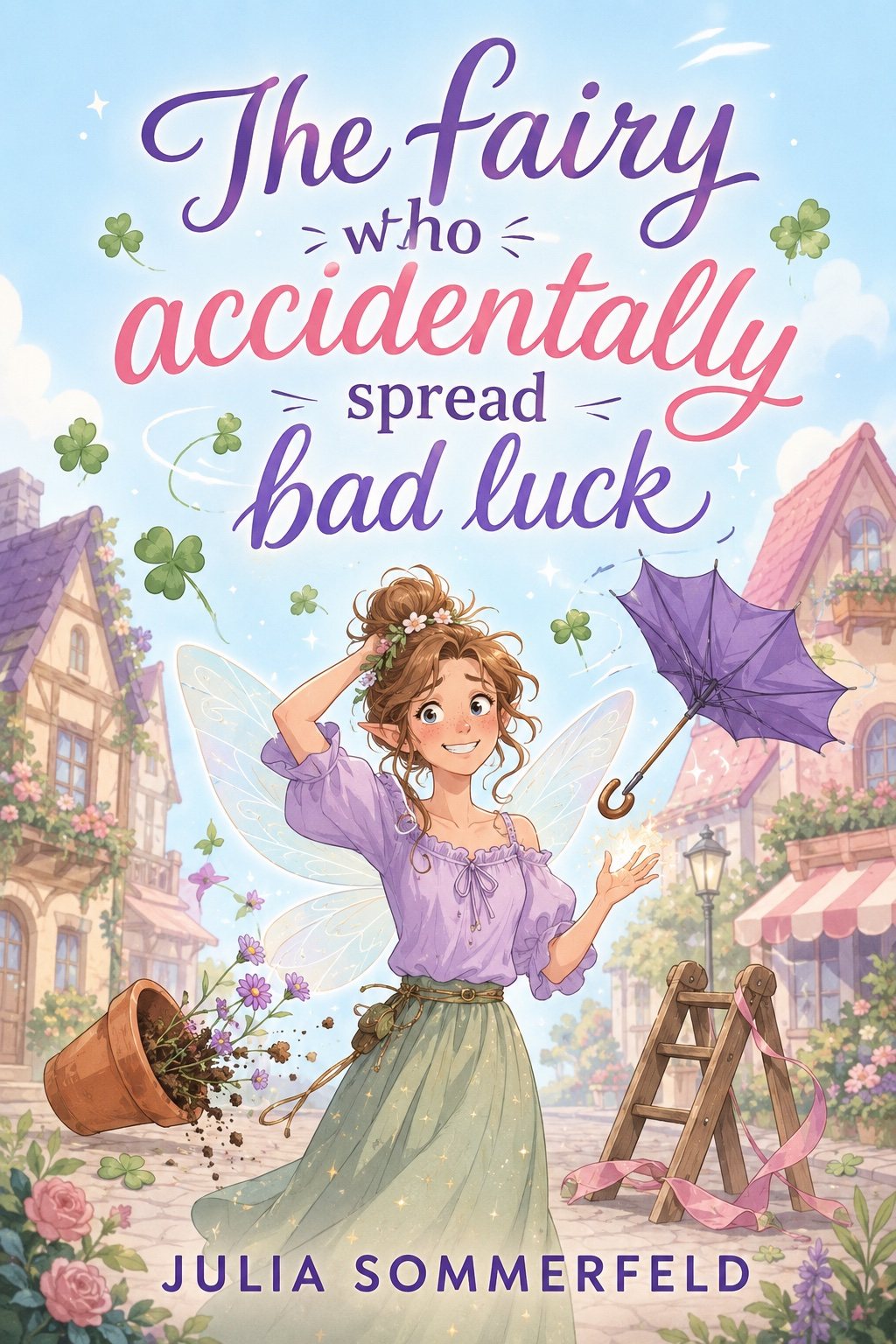
The fairy who accidentally spread bad luck
- Romantasy
No signup, no paywall · the full story continues in the app
The story
On her graduation trial, Fiona tries to grant “a wonderful day” to an old lady—only to unleash twelve love-struck pigeons and a surprise engagement that lands like a disaster banner over the entire fairy court. Slow-burn, opposites-with-comfort: Fiona is impulsive, anxious, and chaos-prone; Benno is calm, practical, and quietly protective—until her “second chances” magic cracks his fear of hope. Feel-good magic that turns embarrassment into healing, and romance that grows through repairing, laughing, and choosing each other again and again.
Chapter 1 · Twelve Pigeons and One Very Angry Engagement · 7 min read
The Fairy Court Training Grounds smelled like fresh cut grass and ink from the trial scrolls. Fiona stood on a wooden platform with her cracked wand wrapped in ribbon like a bandage. Her wand still looked pretty. It was her hands that shook.
“Remember,” Master Linder had said, voice too calm for how hard he was staring at her. “Luck is not chaos. Luck is care.” Fiona had nodded like she understood care. Now she watched the old lady on the front bench wipe her glasses and look tired, not hopeful.
The old lady’s name was Aunt Milda. She had come for Fiona’s graduation trial, because in fairy court rules, someone had to be willing to receive a blessing. Aunt Milda’s smile was polite. It did not reach her eyes.
Fiona stepped forward, lifted her wand, and tried to swallow the fear that tasted like cold sugar. She had practiced the words for days. She had even practiced them quietly into her pillow so no one would hear her panic.
She raised her voice. “Aunt Milda, I want to grant you a wonderful day.”
A spark jumped from her wand to the air above Aunt Milda’s head. It should have turned into warm light, like the training dummies showed. Instead, the spark fizzed and scattered into a ring of tiny, pale feathers.
“Uh—” Fiona began, because her mouth always tried to fix things with sound. The ring widened, and then twelve pigeons dropped out of it as if the sky had suddenly decided to cough.
They landed on the benches. They landed on Aunt Milda’s shawl. They cooed in the same rhythm, like they had rehearsed. Aunt Milda stared at them with slow disbelief. One pigeon blinked at Fiona, smug as a judge.
Fiona’s luck magic was supposed to amplify the feeling she aimed for. She had aimed for joy. She had aimed for softness. She had not aimed for birds with opinions.
She took one careful step, wand still up. “Okay,” she said to the pigeons, because she had learned that talking to chaos sometimes helped. “You’re… you’re very enthusiastic. But please disperse.”
The pigeons did not disperse. They lifted their heads together and cooed again. Aunt Milda, who had been holding her breath, suddenly let out a sharp laugh, like a broken bell trying to be friendly.
Then Aunt Milda’s eyes darted past Fiona to the side of the platform. A gardener stood there, waiting to bring her a small basket of herbs for the trial. He wore soil on his boots and calm on his face. He looked surprised, but not scared.
The pigeons turned toward him. Every single one. Their cooing changed. It softened into something that sounded, terribly, like romance.
The gardener cleared his throat. “Are those—” he started.
Aunt Milda stood up too fast. Her shawl slipped. One pigeon hopped closer to her hand, as if offering a role in a play. Aunt Milda reached for the basket of herbs. The basket tilted. A little twig of rosemary popped out and landed in her palm like a ring.
Fiona’s stomach dropped. Rosemary was not a ring. It was food. It was dinner. It was—
Aunt Milda blinked at the rosemary, then looked at the gardener. Her voice came out firm, as if she had decided something years ago and only now found the words. “You,” she said, “have been helping my garden for two seasons. I think I will accept your proposal.”
The gardener stared at the rosemary twig like it had just grown teeth. “I did not propose,” he said. “I only brought herbs because you asked for parsley.”
Aunt Milda’s cheeks turned pink. She looked offended at reality itself. “Then,” she said, voice rising, “you propose with your hands, and your hands are very convincing.”
Fiona could feel the court’s attention tighten. She could feel the air get colder, like someone had opened a window in a room full of judges. She tried to breathe. She tried to remember the lesson: luck is care.
She moved fast, too fast. “Wait,” she blurted, and the wand ribbon slipped under her thumb. The cracks in her wand caught the light. A second shimmer flashed—this time aiming for calm.
The pigeons did not calm. They leaned into the gardener like they were pushing him toward a yes. Aunt Milda hugged the rosemary twig to her chest like it was evidence.
The gardener took one step back. “Please,” he said, and now his face showed real panic. “I can’t marry someone because of—because of pigeons.”
Fiona’s embarrassment hit like heat. She had done this. She had misfired again. Her luck spells misfired into oddly specific disasters, and everyone in the court knew it. She had been trying to prove she was not dangerous.
Aunt Milda looked ready to cry or shout. The pigeons cooed louder, as if they could smell fear. Fiona lifted her wand with both hands, like she could hold her magic steady through sheer effort.
“No,” Fiona whispered. “You don’t get to decide for them.”
She pictured the day she wanted: warm tea, gentle laughter, nothing chasing anyone. She pushed her intention into the air. Light spilled outward in a soft circle.
The circle hit the pigeons like a gentle wind. Twelve birds froze mid-coo, then flapped backward in a tight line. They slipped through the air as if the shimmer had made a door. In three seconds, the benches were empty of pigeons.
Aunt Milda exhaled. The gardener exhaled too, as if he had been underwater. Fiona exhaled last, and her knees nearly gave up.
The rosemary twig fell from Aunt Milda’s palm and landed on the floor with a tiny snap. It looked like nothing. It looked like a mistake. It also looked like a promise that had not been meant.
Fiona bent quickly, picked it up, and held it out. “I’m sorry,” she said to both of them. “I meant a wonderful day. I did not mean… an angry engagement.”
Aunt Milda took the rosemary, still red-faced. She did not shout. That made Fiona feel worse, because calm meant she was truly disappointed. “My garden will survive,” Aunt Milda said. “But my pride will need watering.”
The gardener nodded once, stiffly polite. “I’ll be back with your parsley,” he said, as if normal work could undo magic.
Fiona straightened. She had panic in her throat, but she forced it down. Panic turned into embarrassed determination. She wanted to prove she wasn’t dangerous, even if her wand kept betraying her.
She looked toward the high balcony where the fairy queen sat. The fairy queen’s gown shimmered like sunlight on water. Her expression did not.
Regina Glanz watched without blinking. Fiona could almost hear the unamused click of the queen’s crown charms. She had trained under strict eyes before, but today the queen’s gaze felt like a locked door.
A faint symbol on Fiona’s cracked wand caught the light as she lowered it. It looked like a small star wrapped in a broken circle. She had never noticed it clearly before. Now it seemed to glow, like a bruise that wanted to be seen.
In the corner of Fiona’s vision, a tiny red-and-black ladybug buzzed onto the railing. Ottokar’s face looked comically serious, but his antennae trembled. He wore a miniature satchel and a ribbon badge that read “Glücksberater.”
“Listen,” Ottokar said, voice like a tiny official announcement. “This is a known pattern.”
Fiona stared at him. “Known?” she squeaked. “Why is it known, if it keeps happening?”
Ottokar lifted one leg as if pointing at the sky. “Because luck spells don’t just hit objects. They hit feelings people try to hide.” He paused, then added, softer, “And you hide your fear very loudly.”
Fiona’s cheeks burned. “I’m not hiding it,” she said. Then she remembered the rule: intention matters less than the emotional target. Her own fear had been strong. Maybe her magic had listened to that.
She glanced back at Aunt Milda and the gardener. Their embarrassment sat between them like a third person. The pigeons had chosen romance, as if the hidden tension had been waiting for a reason.
Ottokar leaned closer. “I’ve heard a rumor,” he said, quick and careful. “That there’s an advisor in the court who can read this kind of misfire. But the last time someone asked for advice out loud, the advisor got blamed.”
Fiona felt alone in that moment. Not just because she was standing in front of the queen. Because Ottokar was only a rumor and a ladybug, and her magic did not care about her plans.
Regina Glanz stood. The balcony steps did not creak. They clicked, like the queen’s patience had edges. “Fiona Flimmer,” she said, and her voice carried over the training grounds. “Your trial has concluded.”
Fiona’s stomach twisted. “Concluded?” she repeated, stupidly. She held her wand like it might run away.
Regina Glanz looked at the empty benches where the pigeons had been. “You attempted to grant ‘a wonderful day,’” she said. “You delivered twelve love-struck pigeons and a forced engagement. I am not amused.”
Fiona’s mouth went dry. She wanted to apologize again, but apology felt like a trap. If she kept apologizing, she would keep being the kind of fairy who only broke things.
The queen lifted one hand. A golden parchment floated down, landing in Fiona’s palms with a weight that was almost physical. The words blurred at first, then sharpened.
Fiona read the verdict aloud without meaning to. “Graduation trial: failed—clearly.”
Ottokar gasped. “Wow,” he said, then tried to sound official. “That is… very direct.”
Regina Glanz did not look at Ottokar. She looked at Fiona as if Fiona were a problem that could be relocated. “You will be punished,” she said. “Exile.”
Fiona’s heart kicked. “Exile?” she whispered. She tried to picture any place in the kingdom where her magic would not be a disaster.
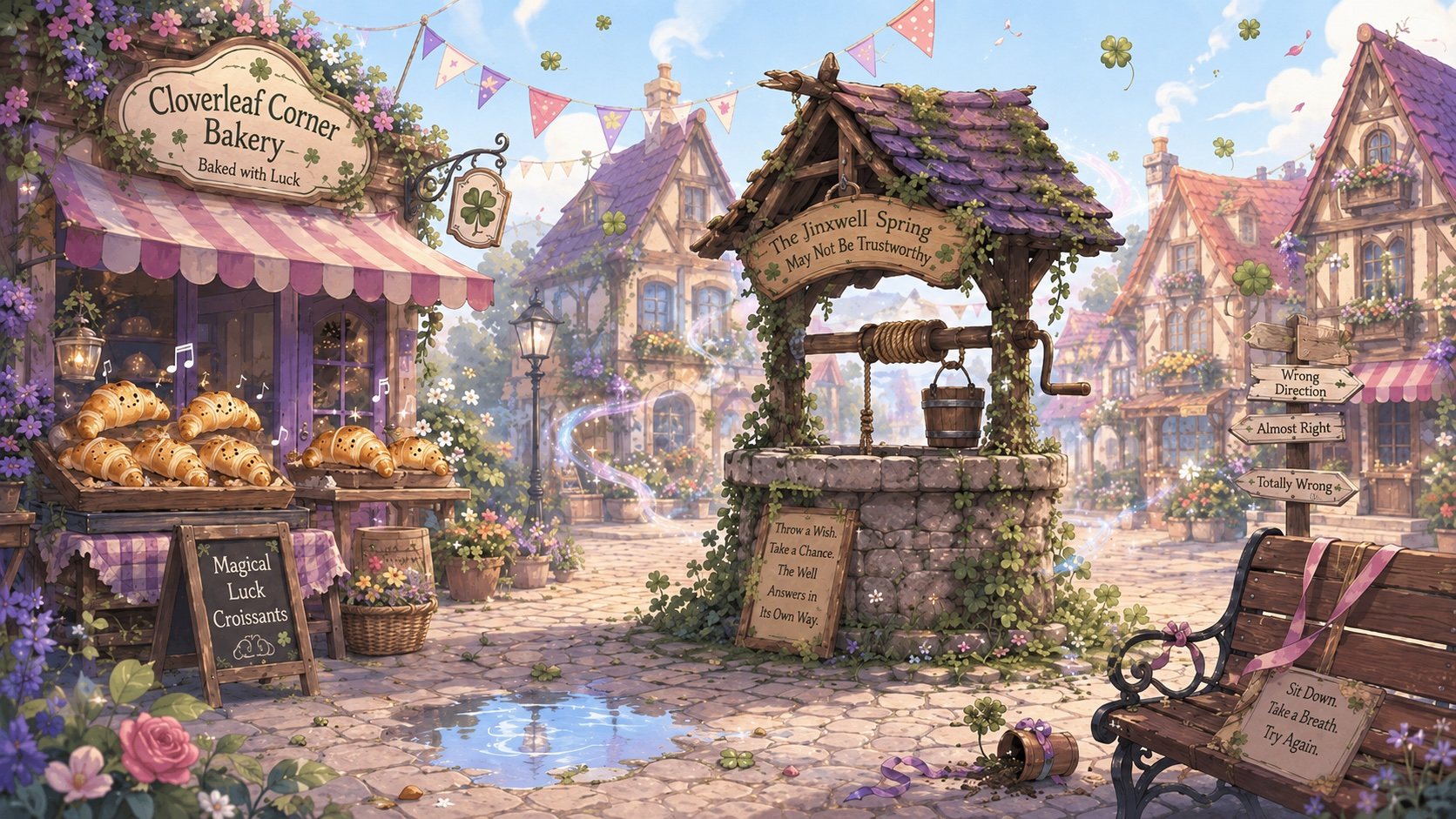
Regina Glanz’s crown charms clicked again. “To the unluckiest village in the kingdom,” she announced. “Kleeblattwinkel.”
The name landed like cold water. Fiona had heard it once, in a training hallway, in a tone people used for storms and bad jokes. The fairy queen stepped closer, her shadow long and bright.
“You will leave at sunrise,” Regina Glanz said. “And you will discover what happens when luck is not perfect enough to hide truth.”
Fiona stared at her cracked wand. The faint symbol on it burned in her mind. She had not known she would need it. She did not know what Kleeblattwinkel would do with a fairy whose magic targeted feelings she did not intend.